Thursday, February 13, 2020

Incident Management on a Single Pane of Glass?

Sameer Hutheesing, AVP,  Business Development, GAVS Technologies, believes it now is possible to correlate most incident reports into a single system. That might not yet be a full AIOPs capability, allowing enterprises to close their network operations centers, but it is hard to argue this is not useful. 

video
 auto discover the network, apps, users

5 Years to Comprehensive AIOPs?

It is not so clear that AIOps is going to be widely deployed in less than five years, argues Frank Yue, Kemp Technologies solutions architect. 

“AIOps is more complex than you think,” said Yue. “It is hard for AI to figure out all the relevant connections” between apps and the network. 

“Network performance monitoring is separate from app performance monitoring; security policy management is different from the separate analytics for each subsystem,” Yue said. The network, server, app, security, storage, WAN and cloud all have to be integrated. 

Then there are the vendor specific solutions that are proprietary, and many different protocols are in use, including HTTP, DNS, BGP, Java and .net. Different languages including XML, Syslog, RTTP REST, SNMP, CLI also must be accommodated. There also are different functions, including server load balancing, routers, switches, Yue said.

It is hard for AI to know, in advance, the context of relationships between systems, apps, actions, he said. So a complete AIOPs platform must be multilingual, multi-vendor, mult-technology and multi-system. 

And “nobody wants to buy 10 AI solutions,” he added. 

There is, in other words, no present way to build a complete and comprehensive monitoring capability with a single pane of glass.

Monday, February 10, 2020

BiogPanda Touts Root Cause Capabilities

BigPanda says it is “the first AIOps solution to ingest changes from disparate change feeds and tools, and correlate and analyze these changes against alerts collected from enterprise monitoring tools to rapidly isolate the root cause change that resulted in an incident or outage.”

The BigPanda platform expansion speeds up incident and outage resolution by ingesting changes from any source of change data, including change management, change log, configuration management, and others, BigPanda says. 

BigPanda’s Root Cause Changes feature uses machine learning to correlate and analyze this dataset alongside the dataset of alerts collected from monitoring tools.

The Real-time Topology Mesh provides a real-time topology model across the entire IT stack, BigPanda says.


Sunday, January 26, 2020

Ultimately, is AIOps a Distinct Market?

The event correlation and modern IT operations analytics markets have been established for some time, but the AIOps market is fairly new. Already, it is hard to separate those markets, as artificial intelligence eventually will be applied to all enterprise software, including anomaly detection features of most software. 

Incident management, broadly stated, is the function of “network monitoring” software and systems, either stand-alone systems or as functions of enterprise software. “AIOps” software and systems, using machine learning or artificial intelligence, is the new category. -

The global AIOps platform market was valued at USD 2.08 Billion in 2018 and is projected to reach USD 21.36 Billion by 2026, growing at a compound annual growth rate of 34 percent from 2019 to 2026, according to Verified Market Research. 

Others believe the market will reach only about $6 billion by 2025, according to Monitor Intelligence; $9 billion by Research and Markets; $12 billion by 2026, according to Verified Market Research and Markets and Markets; $11 billion by 2023, according to Markets and Markets; or $16 billion by 2025, according to Research and Markets. 

Much hinges on how one defines a platform and therefore how many companies are assumed to be in the market, as well as differences of opinion about the actual growth rate. 

The other problem is that AIOps capabilities increasingly will be bundled with core functions of enterprise monitoring systems generally. So it will be hard to clearly separate AIOps from other enterprise software and system sales.

How Big Will AIOps Market be by 2026?

The global AIOps platform market was valued at USD 2.08 Billion in 2018 and is projected to reach USD 21.36 Billion by 2026, growing at a compound annual growth rate of 34 percent from 2019 to 2026, according to Verified Market Research. 

Others believe the market will reach only about $6 billion by 2025, according to Monitor Intelligence; $9 billion by Research and Markets; $12 billion by 2026, according to Verified Market Research and Markets and Markets; $11 billion by 2023, according to Markets and Markets; or $16 billion by 2025, according to Research and Markets. 

Much hinges on how one defines a platform and therefore how many companies are assumed to be in the market, as well as differences of opinion about the actual growth rate. 

The other problem is that AIOps capabilities increasingly will be bundled with core functions of enterprise monitoring systems generally. So it will be hard to clearly separate AIOps from other enterprise software and system sales.

Friday, January 3, 2020

AI Adoption by Enterprises Up 80% Next 2 Years, IBM Predicts

AIOps seems inevitable, simply because artificial intelligence will become a basic tool supporting virtyally all enterprise and consumer applications, devices and platforms in coming years.

A new survey commissioned by IBM leads the firm to predict that adoption of AI in the corporate world will climb dramatically over the next 18 to 24 months, exploding to 80 percent or even 90 percent. 


Global companies are planning to heavily invest in all areas of AI over the next 12 months, IBM says, including:
  • Proprietary AI solutions: 35 percent
  • Off the shelf applications: 34 percent
  • Off the shelf tools to build their own AI models: 33 percent
  • Reskilling and workforce development: 33 percent
  • Embedding AI into current applications and processes: 28 percent
  • R&D: 26 percent

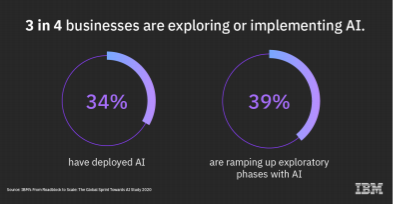
Across industries, most global businesses have either deployed artificial intelligence in their business (34 percent) or are ramping up exploratory phases with AI (39 percent), meaning almost three in four businesses surveyed are in the AI game.

Large companies are leading AI adoption, with 45 percent of firms over 1,000 citing adoption of AI compared to 29 percent of companies under 1,000 employees. 

"Business is in a Near Constant State of Flux"

A survey of 300 information technology professionals by App Associates shows the impact of cloud migration for Oracle users. About 37 percent of respondents already have migrated Oracle operations to the cloud, while 57 percent are in the process of doing so. Only five percent say they are “planning to migrate.” Just one percent say they have no plans to move to cloud delivery. 


Among the implications noted by App Associates is that “business is in a near constant state of flux.” And that often is cited as a reason for the value of AIOps.

MWC and AI Smartphones

Mobile World Congress was largely about artificial intelligence, hence largely about “AI” smartphones. Such devices are likely to pose issue...