Tuesday, July 19, 2022

For Most of Us, AI is a Feature of a Product

For suppliers of artificial intelligence infrastructure, AI is a direct revenue source. For most of the rest of us, AI is a feature of some other product we buy or use. Amazon, for example, uses AI to drive its $222 billion e-commerce business plus its $103 billion third-party merchant revenues.


AI also underpins Amazon Web Services, subscriptions and advertising. 


source: Mozilla 


Digital Twins are Representations of the Real World, But Beyond That We do Not Yet Agree on Value

Any new technology brings new definitions. But to replace an existing technology, it also has to bring business or consumer value. Consider digital twins. How does a digital twin add value over existing monitoring and sensing systems, for example? Throw in new internet of things sensors and the definitions and use cases are even more complicated. 


Most definitions of digital twins involve the virtual representation of some real-world process. But that might be the only thing observers agree upon. 


If we assume the value of IoT is the ability to know what is happening, in real time, with processes and machines, we can understand the difference between real-time monitoring and non-real-time simulations, for example. The former tells you what is happening; the latter what could happen. 


Most proponents of digital twins emphasize its value over a “simulation.”


“A simulation replicates what could happen to a product, but a digital twin replicates what is happening to an actual specific product in the real world,” says TWI Global. “A digital twin creates a virtual environment able to study several simulations, backed up with real-time data and a two-way flow of information between the twin and the sensors that collect this data.”


source: TWI Global 


But we might also say a digital twin is a three-dimensional representation of “what is happening.” In that sense it is closer to the idea of a monitoring or sensing system able to fully represent many real-world conditions. 


Some might say that “simulations refer to digital models that imitate the operations or processes within a system.” Others might emphasize the more-static nature of a simulation, versus dynamic nature of a twin. 


But even those definitions are fuzzier than one might think. Digital twins can also be used for simulations, albeit with more realism and dynamism, even if most observers say the primary value is operations visibility. For some enterprises, the issue might be the amount of incremental value from a digital twin, compared to a robust IoT monitoring system. 

source: Softserve 


Others might focus on the difference between “intent” and “status.” 


“Simulations are created by the imagination of the designer, who will use them to analyze the cause and effect of different scenarios, mostly offline,” says Ericsson, also noting that the variety of definitions is “overwhelming.”


For example, a digital twin can be defined as software representation of assets and processes, which is enhanced with capabilities that are not present in the real-world entity. A digital twin “is a virtual copy of something, and processes associated with it, that can be used to predict or interact with reality,” Ericsson also says. 


Again, note the complexity of the concept. A digital twin is a virtual copy of something. But its uses can range from monitoring to simulation to process control. 


Some might argue that, in most cases, a simulation is a snapshot of a one-time task, which is then used to support design and analysis studies. But a digital twin might also support real-time simulations, in addition to monitoring and process control.


Digital twins, on the other hand, are driven by timely synchronization of information between the real and virtual worlds, and therefore adapt with changes in either world. Simulations are predominantly theoretical, whereas digital twins are specific and actual, some might say. 


Similarly, digital twins share some similarities with metaverses: digital spaces where people can interact virtually. But metaverses are built intentionally, typically representing virtual realms.


Digital twins only have value as replicas of the real world. That is about the only definition we might all agree upon. The value and use cases will be matters of interpretation.


Monday, July 18, 2022

Intel Struggles with Movement into Adjacencies, Just Like Telcos

Intel is not immune from the general trend to turn products into services. Nor is Intel protected from initiatives that do not develop as fully as expected. Sometimes it works; often it does not. That is the risk firms take with innovation.  


And, as always, questions are raised about strategy: stick on the core business or diversify. Telcos face the same problem as Intel does, in one important respect: acquisitions in growth areas mean spending a growth multiple to acquire the assets. In other words, Intel and ISPs have to buy high-value assets using low-value currencies.  


So the typical problem for tier-one telcos is debt, which more than anything else causes telcos to reverse course quite often. 


Analysts and advisors often disagree sharply about what telcos ought to do about their “growth” initiatives. Some favor “sticking to core connectivity” while others emphasize “diversifying beyond connectivity.”  


Service providers have tried both approaches, sometimes alternating between them, as competitive opportunities and threats come and go. 


Some service providers are fortunate to operate in markets with high profit margins. In such markets the advice to “stick to connectivity” can make sense. Others have fewer chances to grow if they stick to connectivity. In those cases diversification makes sense. 


But almost every service provider explores some growth opportunities outside the core connectivity business. How to do so remains the challenge. Growth initiatives are risky, expensive and often do not move the revenue needle very much. 


And such initiatives almost always are fueled by debt. In almost all cases, such efforts are reversed when priorities shift back to core business investment and debt reduction. 


The other approach is to try to grow new capabilities organically. That can reduce the danger of debt, but at the risk of not being able to scale quickly. 


It’s a huge issue, for Intel or ISPs.


Monday, July 11, 2022

No Metaverse Yet Except Partially in Gaming

At the moment, it would be hard to argue that anything substantial in the “metaverse” or “web3” areas happens anywhere except for gaming. 


Most observers might agree that substantial revenue opportunity exists for communications and e-commerce. The value is realism for the former and latter use cases. 


source: Rafael Brown 


Metaverse Will be a Huge Wasted Capital Event for Many

Lots of firms are going to waste a lot of money on metaverse investments early on. It almost cannot be helped. Outside of gaming, where one can see use cases, full metaverse spaces are not yet developed enough to provide near-term commercial benefit.

Friday, July 1, 2022

Virtualization, Disaggregation Increase Risk of Outages

As computing architectures become more disaggregated and virtualized, it is almost inevitable that outages caused by the use of many more network elements, platforms, suppliers, operating systems and applications will grow. 


Multi-cloud computing, hybrid computing, edge computing and remote computing all mean that the availability of transport and access fabrics now is part of the availability performance. 

source: Uptime Institute 


Prolonged downtime is becoming more common in publicly-reported outages, Uptime Institute says. Also, outages are lasting longer. 


The gap between the beginning of a major public outage and full recovery has stretched significantly over the last five years, with nearly 30 percent of these outages in 2021 lasted more than 24 hours, according to the Uptime Institute. 


source: Uptime Institute


Human error also drives some downtime, in addition to network element, server, configuration or other  software failures. 

source: Uptime Institute 

Why Metaverse Might Take 30 Years to Reach Ubiquity

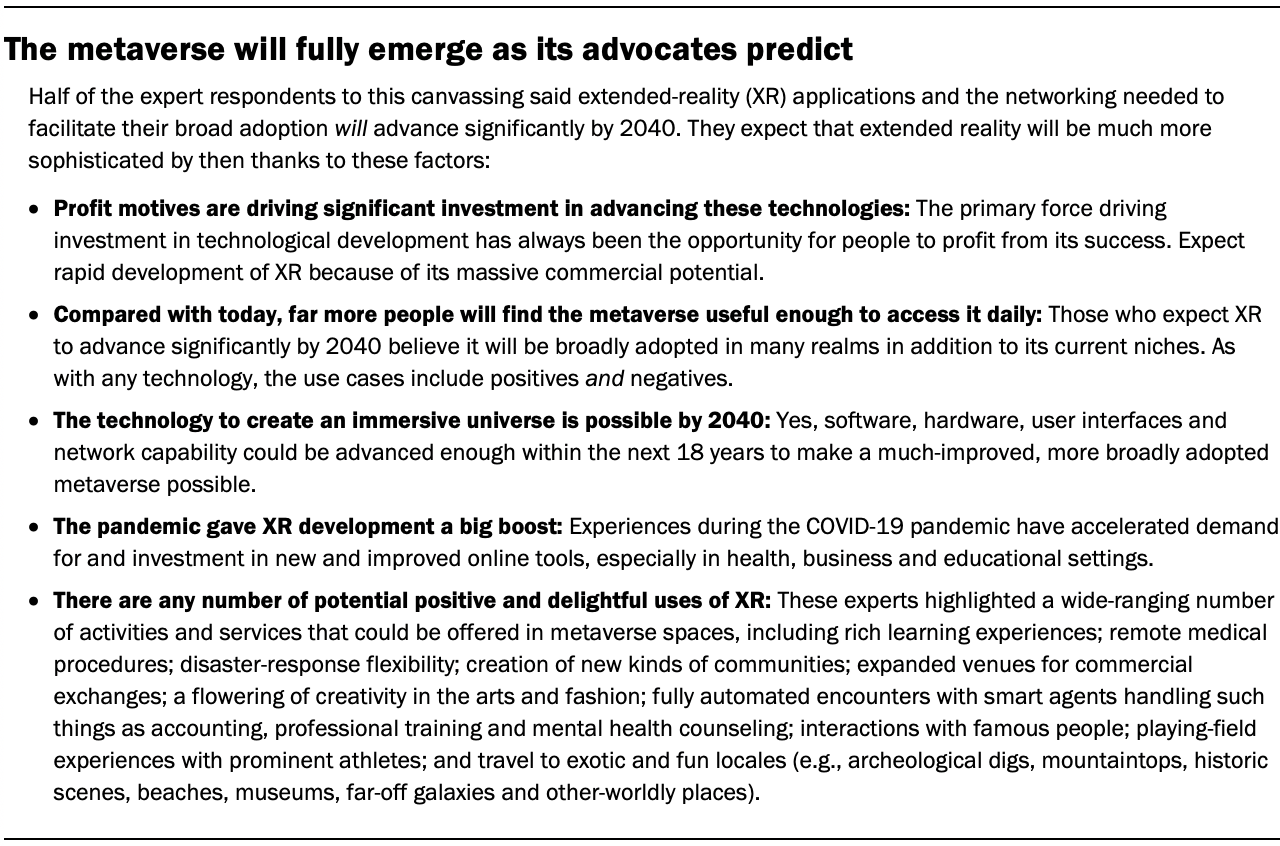
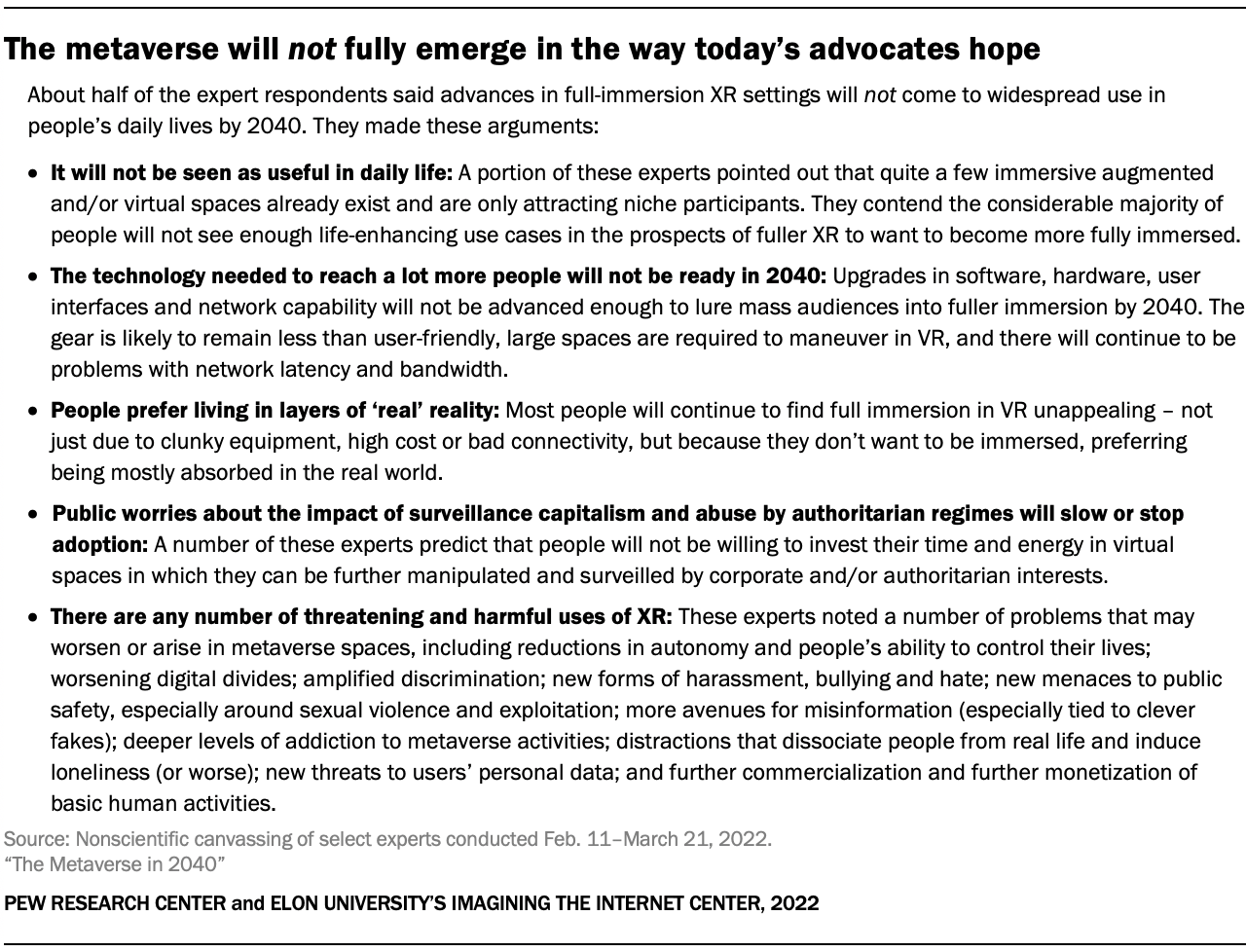
Experts surveyed by Pew Research believe that augmented and mixed-reality applications will dominate full virtual reality environments in 2040. But half of the experts also believe the “metaverse” will not be common in the lives of most consumers by that point. 

A table showing two meta themes that anchored many experts' predictions

A table showing the reasons The metaverse will fully emerge as its advocates predict

A table showing the reason thatThe metaverse will not fully emerge in the way today’s advocates hope

source: Pew Research 


This will be unwelcome news for many metaverse proponents. But it is historically realistic. 


Major technology transitions typically take much longer than proponents expect. One common facet of new technology adoption is that change often comes with a specific pattern: a sigmoid curve such as the Gompertz model or Bass model. 


S curves explain overall market development, customer adoption, product usage by individual customers, sales productivity, developer productivity and sometimes investor interest. It often is used to describe adoption rates of new services and technologies, including the notion of non-linear change rates and inflection points in the adoption of consumer products and technologies.


In mathematics, the S curve is a sigmoid function. It is the basis for the Gompertz function which can be used to predict new technology adoption and is related to the Bass Model.


Such curves suggest a longish period of low adoption, followed by an inflection point leading to rapid adoption.


That leads supporters to overestimate early adoption and vastly underestimate later adoption. Mobile phone adoption, and smart phone adoption, illustrate the process. You might think adoption is a linear process. In fact, it tends to be non-linear.


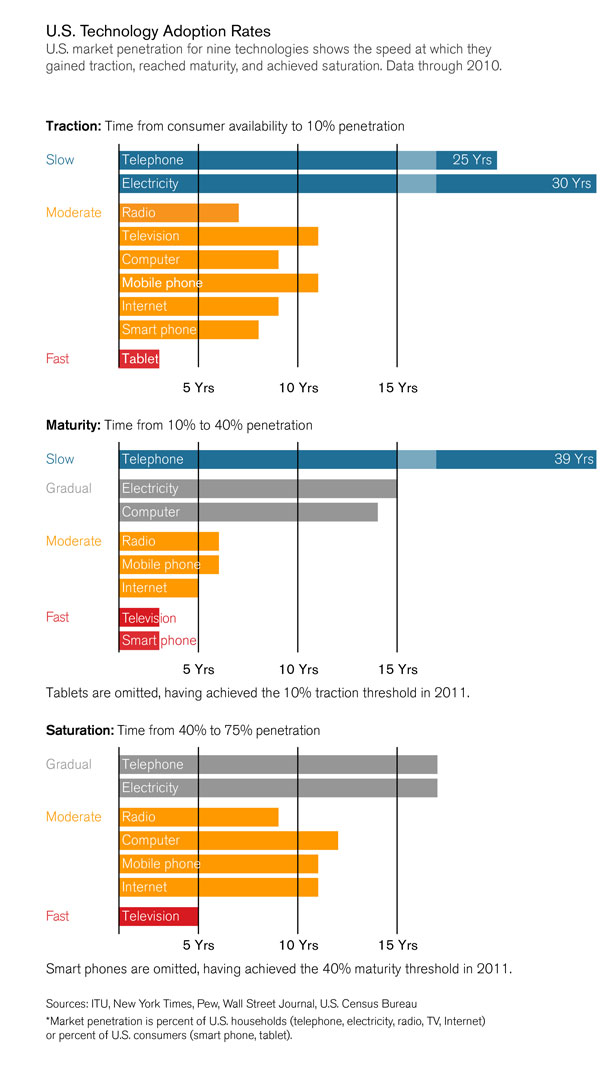
Also, the more fundamental the change, the longer to reach mass adoption. Highly-useful “point technologies” such as telephones, electricity, mobile phones, smart phones, the internet and so forth can easily take a decade to reach 10-percent adoption. Adoption by 40 percent of people can take another decade to 15 years. And adoption by more than 40 percent of people can take another decade to 15 years. 


source: MIT Technology Review 


That suggests a 30-year adoption cycle for a specific innovation that has high value to be used by 40 percent to 70 percent of people. Something such as metaverse, which is far more complicated, could easily take 30 years to reach 40 percent of people in ordinary use. 


That might mean at least a decade before metaverse apps are in common use by 10 percent of people. Even then, use cases are likely to be dominated by gaming, business communications and video entertainment. 


source: Robert Patterson 


The sigmoid function arguably is among the most-important mathematical expressions one ever encounters in the telecom, application and device businesses. It applies to business strategy overall, new product development, strategy for legacy businesses, customer adoption rates, marketing messages and  capital deployment, for example. 


The sigmoid function applies to startups as well as incumbents; software and hardware; products and services; new and legacy lines of business. 

source: Innospective


The concept has been applied to technology adoption in the notion of crossing the chasm of value any technology represents for different users. Mainstream users have different values than early adopters, so value propositions must be adjusted as any new technology product exhausts the market of early adopters. Early adopters can tolerate bugs, workarounds or incomplete on-boarding and support experiences. They tend to be price insensitive. 


It always takes longer than one expects for a major new innovation to become ubiquitous. Metaverse, being a complicated development, might take longer than any point innovation.

MWC and AI Smartphones

Mobile World Congress was largely about artificial intelligence, hence largely about “AI” smartphones. Such devices are likely to pose issue...