Sunday, January 26, 2020

Ultimately, is AIOps a Distinct Market?

The event correlation and modern IT operations analytics markets have been established for some time, but the AIOps market is fairly new. Already, it is hard to separate those markets, as artificial intelligence eventually will be applied to all enterprise software, including anomaly detection features of most software. 

Incident management, broadly stated, is the function of “network monitoring” software and systems, either stand-alone systems or as functions of enterprise software. “AIOps” software and systems, using machine learning or artificial intelligence, is the new category. -

The global AIOps platform market was valued at USD 2.08 Billion in 2018 and is projected to reach USD 21.36 Billion by 2026, growing at a compound annual growth rate of 34 percent from 2019 to 2026, according to Verified Market Research. 

Others believe the market will reach only about $6 billion by 2025, according to Monitor Intelligence; $9 billion by Research and Markets; $12 billion by 2026, according to Verified Market Research and Markets and Markets; $11 billion by 2023, according to Markets and Markets; or $16 billion by 2025, according to Research and Markets. 

Much hinges on how one defines a platform and therefore how many companies are assumed to be in the market, as well as differences of opinion about the actual growth rate. 

The other problem is that AIOps capabilities increasingly will be bundled with core functions of enterprise monitoring systems generally. So it will be hard to clearly separate AIOps from other enterprise software and system sales.

How Big Will AIOps Market be by 2026?

The global AIOps platform market was valued at USD 2.08 Billion in 2018 and is projected to reach USD 21.36 Billion by 2026, growing at a compound annual growth rate of 34 percent from 2019 to 2026, according to Verified Market Research. 

Others believe the market will reach only about $6 billion by 2025, according to Monitor Intelligence; $9 billion by Research and Markets; $12 billion by 2026, according to Verified Market Research and Markets and Markets; $11 billion by 2023, according to Markets and Markets; or $16 billion by 2025, according to Research and Markets. 

Much hinges on how one defines a platform and therefore how many companies are assumed to be in the market, as well as differences of opinion about the actual growth rate. 

The other problem is that AIOps capabilities increasingly will be bundled with core functions of enterprise monitoring systems generally. So it will be hard to clearly separate AIOps from other enterprise software and system sales.

Friday, January 3, 2020

AI Adoption by Enterprises Up 80% Next 2 Years, IBM Predicts

AIOps seems inevitable, simply because artificial intelligence will become a basic tool supporting virtyally all enterprise and consumer applications, devices and platforms in coming years.

A new survey commissioned by IBM leads the firm to predict that adoption of AI in the corporate world will climb dramatically over the next 18 to 24 months, exploding to 80 percent or even 90 percent. 


Global companies are planning to heavily invest in all areas of AI over the next 12 months, IBM says, including:
  • Proprietary AI solutions: 35 percent
  • Off the shelf applications: 34 percent
  • Off the shelf tools to build their own AI models: 33 percent
  • Reskilling and workforce development: 33 percent
  • Embedding AI into current applications and processes: 28 percent
  • R&D: 26 percent

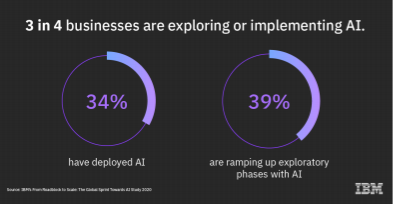
Across industries, most global businesses have either deployed artificial intelligence in their business (34 percent) or are ramping up exploratory phases with AI (39 percent), meaning almost three in four businesses surveyed are in the AI game.

Large companies are leading AI adoption, with 45 percent of firms over 1,000 citing adoption of AI compared to 29 percent of companies under 1,000 employees. 

"Business is in a Near Constant State of Flux"

A survey of 300 information technology professionals by App Associates shows the impact of cloud migration for Oracle users. About 37 percent of respondents already have migrated Oracle operations to the cloud, while 57 percent are in the process of doing so. Only five percent say they are “planning to migrate.” Just one percent say they have no plans to move to cloud delivery. 


Among the implications noted by App Associates is that “business is in a near constant state of flux.” And that often is cited as a reason for the value of AIOps.

Saturday, December 21, 2019

Cloud Computing Complicates Enterprise IT Operations

Cloud computing at least indirectly is creating complexity for enterprise information technology managers, as a single web or mobile transaction now crosses an average of 37 different technology systems or components, a survey by Dynatrace finds. 

About 76 percent of IT professionals surveyed by Dynatrace say they do not have complete cloud application performance visibility.


That is one problem AIOps hopes to alleviate, providing greater application performance while reducing monitoring overhead. 


Monday, December 9, 2019

AIOps Value and Application

The value of AIOps--as noted by Gartner, includes the ability to:

  • Reduce noise (false alarms)
  • Determine causality, identifying the probable cause of incidents
  • Capture anomalies
  • Detect trends that may result in outages before their impact is felt
  • Drive the automation of low-risk to medium-risk recurring tasks
  • Improve user effectiveness and automation using chatbots and virtual support assistants (VSAs) 
  • Triage problems

Gartner groups AIOps solutions into three buckets:

  • Domain-agnostic AIOps — Vendors going to market with a general-purpose AIOps platform. These products tend to rely mostly on monitoring tools to perform data capture and cater to the broadest use cases.
  • Domain-centric AIOps — Vendors that have the key components, but with a restricted set of use cases. They essentially do the same thing they did before but now they’re replacing rules, heuristics and fingerprints with math (algorithms). These vendors are focused on one domain (for example, network, endpoint systems or APM). However, there have been some efforts by domain-centric solutions to hybridize these categories and evolve to ingesting data from sources other than their own instrumentation tools and including this data in their analysis.
  • Do-it-yourself (DIY) — Some open-source projects enable users to assemble their own AIOps platforms by offering tools for data ingest, a big data platform, ML and a visualization layer. End users can mix and match the components from multiple providers. 

Illustrative suppliers of domain-agnostic AIOps include firms such as:


Some enterprises actively build AIOps platforms by putting together all the required layers starting with streaming to acquire data (using Prometheus, for example), followed by aggregation (in InfluxData’s InfluxDB, for example) and a visualization tool (such as Grafana or Elastic Kibana), Gartner says. 

Some advanced adopters of do-it-yourself  AIOps platforms have built solutions that analyze the confidence level of their deployments in order to gauge risk, predict customer churn, and detect and automatically resolve problems before they have business impact. However, these deployments are in the minority, due to the skills needed to support them, maintenance requirements and support, Gartner adds. 

Domain-centric AIOps suppliers are further delineated by Gartner into those in the information technology service management (ITSM) space, others in the DevOps space and some in the Network Performance Monitoring and Diagnostics  (NPMD) or application performance monitoring (APM) segments of the market. 


Use of AI in IT operations has been driven by the adoption of digital transformation and the resultant need to address the following:

  • Rapid growth in data volumes generated by the IT systems, networks and applications
  • Increasing data variety with the need to analyze events, metrics, traces (transactions), wire data, network flow data, streaming telemetry data, customer sentiment and more
  • The increasing velocity at which data is generated, as well as the increasing rate of change within IT architectures and challenges in maintaining observability and improving engagement due to the adoption of cloud-native and ephemeral architectures
  • The need to intelligently and adaptively automate recurring tasks and predict change success and SLA failure
  • Use of AIOps platforms to augment IT functions such as event correlation and analysis, anomaly detection, root cause analysis and natural language processing is growing rapidly. However, use of AIOps for functions such as ITSM and DevOps is progressing at a slower pace.
  • AIOps platform offerings have split into two approaches: domain-agnostic and domain-centric solutions.
  • Enterprises that adopt AIOps platforms use them as a force multiplier for monitoring tools correlating across application performance monitoring, IT infrastructure monitoring, network performance monitoring and diagnostics tools, and digital experience monitoring.
  • AIOps platform maturity, IT skills and operations maturity are the chief inhibitors to rapid time to value. Other emerging challenges for advanced deployments include data quality and lack of data science skills.

Sunday, December 8, 2019

Asia Data Centers Adopted Artificial Intelligence to Deal with Operating Cost

Data center owners and operators are concerned about high operating costs as much as any other enterprises, with 61 percent of surveyed Asia Pacific data center professionals saying they have adopted artificial intelligence for operations, according to a survey by Data Center Dynamics.

AI or machine-based analysis and application technologies are reported used by 15 percent to 25 percent of respondents, roughly the same percentages that report having adopted big data analytics, internet of things or software-defined infrastructure. 


High operating costs were the most-frequently-mentioned reasons for using AI in the data center. 
source: Data Center Dynamics

MWC and AI Smartphones

Mobile World Congress was largely about artificial intelligence, hence largely about “AI” smartphones. Such devices are likely to pose issue...