Wednesday, March 24, 2021

Complexity Drives AIOps Interest

Complexity has been one reason for interest in AIOps. 


In the last year, the number of enterprises with over 500 known applications has grown by almost 50 percent, from 32 percent to 47 percent of respondents In parallel, those reporting greater than 20 SaaS applications grew by 37 percent, from 24 percent to 33 percent, according to Aryaka Networks’ State of the WAN report. 


With growth comes complexity, which is still the #1 issue for IT on par with last year at 37 percent, followed by slow application access (33 percent) and performance (32 percent). One area that stood out was cost, identified by 20 percent in 2021 vs 16 percent in 2020, a 25 percent rise. IT Time Sinks: Complexity results in increased resource requirements, spanning slow performance for both the branch and remote workers (44 percent), security breaches (38 percent), integration of cloud and SaaS applications (36 percent), and managing telcos (33 percent).


Monday, February 15, 2021

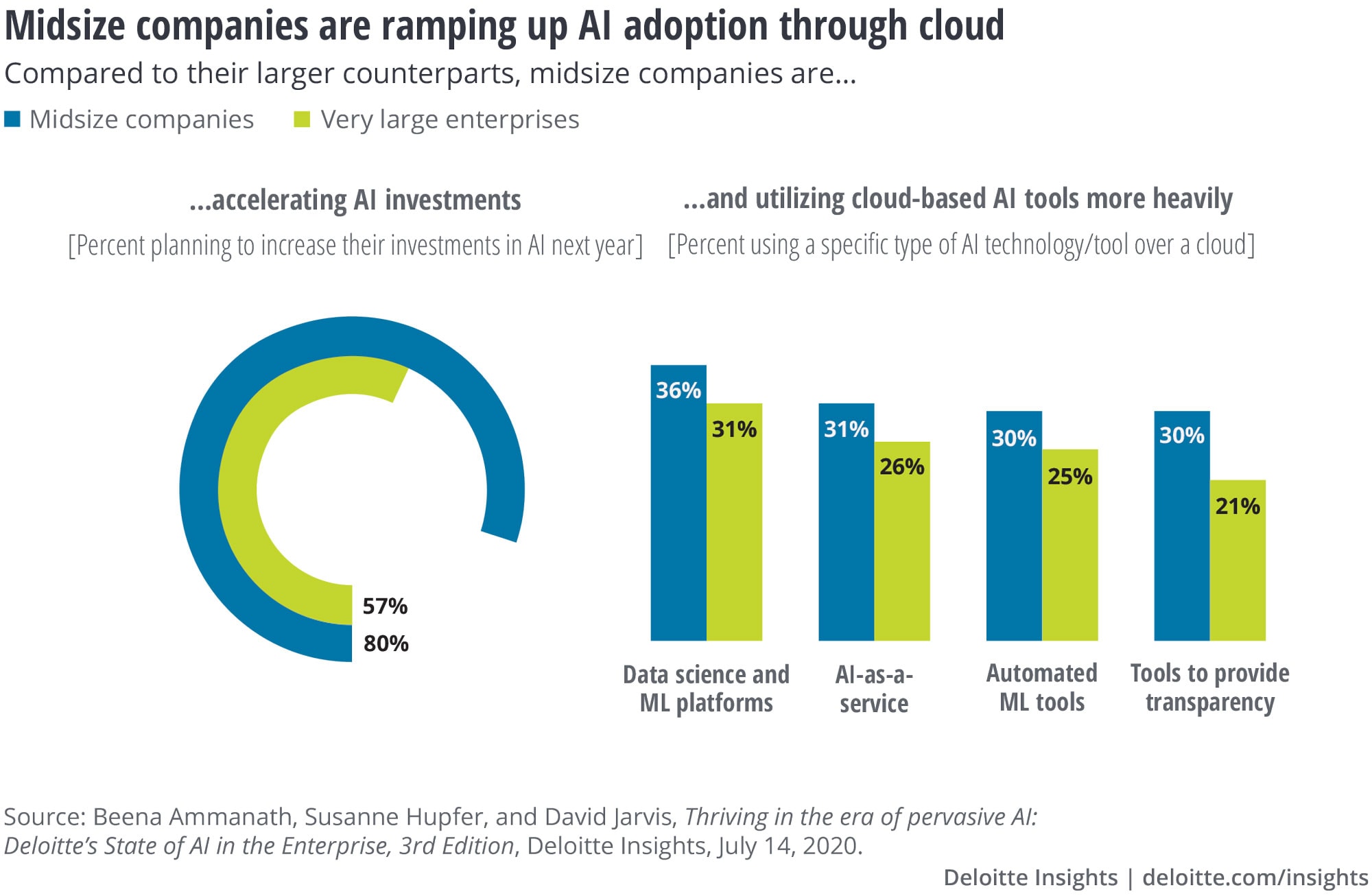
Mid-Size Firm AI Adoption is Likely Mostly Happening as they Adopt Cloud-based Enterprise Apps

For most companies and people, artificial intelligence is not a product, but a capability possessed by a cloud-based business application, such as customer relationship management, enterprise resource planning, supply chain management, or human capital management. 


For that reason, mid-size firms “adopting” AI are largely doing so by adopting cloud-based enterprise applications. 


source: Deloitte 


Tuesday, February 2, 2021

Some Firms Boosted AI Spending During Covid-19 Pandemic

If the Convid-19 pandemic affected enterprise information technology investments, it arguably has slowed such investments at some firms, which have had to shift support to remote workers. On the other hand, some firms who already have found use cases, and invested more heavily prior to the pandemic, seem to have increased their investment level, a  McKinsey survey found.


Respondents from 61 percent of firms who report success with AI also say their firms increased investment in 2020. Patterns across industries show big variations.


 source: McKinsey


Firms in healthcare, pharma, medical products; as well as companies in the automotive industry were most likely to have increased AI investments in 2020. 


 source: McKinsey


Most enterprises likely have not yet found clear financial benefits from AI deployment, though. A survey of more than 3,000 company managers about their AI spend found just 10 percent had gotten significant financial benefits from their investment so far, a report from MIT Sloan Management Review and Boston Consulting Group found. 


A separate survey of U.K. firms found that 40 percent of 750 surveyed U.K. executives plan to invest in artificial intelligence in 2021, a survey by Fountech Solutions finds. 


Some 30 percent of respondents say their firms piloted an AI solution for the first time since the onset of the Covid-19 pandemic. New AI specialists will be hired by 41 percent of respondent firms. Also, 48 percent of respondents say their companies will seek AI training for existing staff.


As a rule, some firms managed to grow revenue and profit during recessions and crises, Boston Consulting Group data suggests. While 44 percent of firms might experience shrinking profit margins and sales growth in a recession or crisis, 14 percent have shown growth in both sales and profits. 


Some 28 percent of firms see lower sales but manage to increase profit margins. About 14 percent of firms see higher sales and lower profit margins. 


Firms in health and consumer staples are most likely to see winners in recessions. Companies in energy, information and communications technology and financial industries are least likely to emerge with higher sales and profits in a recession.


source: Boston Consulting Group 


It is possible--even likely--that firms continuing to invest in AI during the Covid-19 pandemic were already finding themselves gaining market share, increasing sales volume and maintaining or increasing profits. 


The McKinsey survey found, for example, that a small number of respondents at some firms attributed 20 percent or more of their firm earnings before interest and taxes (EBIT) to AI. Those companies planned to invest even more in AI during the COVID-19 pandemic. 


That is in keeping with the BCG data suggesting some firms gain market share and boost sales during recessions and crises. If such gains are attributed to AI, it makes sense that firms would maintain or boost such investments.


Saturday, January 2, 2021

ModelOps for Deploying AI

The term ModelOps refers to the governance and life cycle management of all artificial intelligence and decision models, including models based on machine learning, knowledge graphs, rules, optimization, linguistics and agents, according to Gartner. 


“In contrast to MLOps, which focuses only on the operationalization of ML models, and AIOps which is AI for IT Operations, ModelOps focuses on the operationalization of all AI and decision models,” Gartner says. 

source: ModelOp


As this video suggests, ModelOps aims to support scaling of artificial intelligence capabilities across an enterprise.


Some of you might see this as an example of an important business strategy, which is to create a new market. That is one way to avoid being “trapped” in battle aimed at taking market share from other competitors, and instead boosting value and uniqueness by competing in a new and different market. 


It is vendor push, to be sure, but such pushes--as opposed to buyer pulls-- fail if it does not align with an enterprise's need to solve a real problem important to its business model.


Thursday, December 31, 2020

And Now, MLOps

We do love our acronyms. Add MLOps--also known as ML CI/CD, ModelOps, and ML DevOps--to the lexicon. It’s perhaps like AIOps in the sense of applying artificial intelligence or machine learning to the information technology operations process. 


“MLOps is an approach that marries and automates ML model development and operations, aiming to accelerate the entire model life cycle process,” says Deloitte. “MLOps features automated pipelines, processes, and tools that streamline all steps of model construction.”


As tends to happen when we develop new acronyms and concepts, we often see new firms emerging. Some might argue MLOps is more an engineering culture using DevOps principles than anything else. 


“MLOps (a compound of “machine learning” and “operations”) is a practice for collaboration and communication between data scientists and operations professionals to help manage production ML (or deep learning) lifecycle,” Wikipedia says. 


Similar to the DevOps or DataOps approaches, MLOps looks to increase automation and improve the quality of production ML while also focusing on business and regulatory requirements, Wikipedia adds.

Wednesday, December 23, 2020

Virtually all Surveyed European and North American Firms Buy SaaS

Nearly half of North American and European firms surveyed spend between one percent and 25 percent of their software budgets on software as a service subscriptions, a survey of 143 North American and European organization information technology spending finds. 

source: Computer Economics 


All of the U.S. firms are buying some SaaS services, as well as 98 percent of the European respondents, the report by Computer Economics reports.


Some 11 percent of North American respondents say they buy nearly all their software in SaaS mode.


MWC and AI Smartphones

Mobile World Congress was largely about artificial intelligence, hence largely about “AI” smartphones. Such devices are likely to pose issue...