Saturday, January 22, 2022

AI Provides Greater Cost Reduction Than Revenue Enhancement Benefits in 2020

A McKinsey survey of global enterprise executives suggests they believe artificial intelligence is boosting bottom line results by about five percent. Some 27 percent of respondents agree with that claim. 


source: McKinsey 


And while AI’s revenue benefits have held steady or even decreased since the previous survey—especially for supply-chain management, where AI was unlikely to compensate for the pandemic era’s global supply-chain challenges—the opposite is true of costs, McKinsey says. 


Respondents report significantly greater cost savings from AI than they did previously in every function, with the biggest year-over-year changes in the shares reporting cost takeout from using AI in product and service development, marketing and sales, and strategy and corporate finance.


Wednesday, October 27, 2021

Who Provides AIOps Now, and How Will that Change Over Time?

Analysts and researchers always must make decisions on scope when studying markets of any sort. Which organizations and firms are included within the data set, and what are the selection criteria? 


The AIOps market, generally considered to consist of information technology operations management by using machine learning or artificial intelligence, typically focuses on suppliers of such software capabilities. 


Omdia highlights ServiceNow, Digitate, BMC, IBM and Splunk, LogicMonitor, Sumo Logi, PagerDuty, StackState, VuNet Systems and Netreo as firms it can include within the AIOps market. 

source: Omdia 


Other observers might say the suppliers include :

AppDynamics

BigPanda

BMC

DataDog

DynaTrace

Moogsoft

New Relic

PagerDuty

ScienceLogic

Splunk


source: ITPro 


And yet others--using different criteria-- would add as many as 50 or so additional firms supplying AIOps capabilities defined to include Cloud Management Platforms, Privileged Access Management (PAM), IoT Platforms, Cloud Migration Tools or Hybrid Cloud Storage


Researchers also have to make decisions about whether AIOps is a feature of another product sold by a company, or a primary product sold by a company. Eventually, one might well argue, every enterprise software system will include the use of ML or AI to provide operating information, just as all enterprise software will use cloud delivery mechanisms. 


That virtually guarantees there will be changes in market boundaries over time. AIOps will simply become part of the capability set for all enterprise software with performance management requirements. 


So AIOps might be redefined as general purpose tools that are extrinsic to any single application or process. To the extent that ML or AI-assisted analysis and monitoring tools are supplied with any particular app, only suppliers of third party tools that monitor across domains might come to be seen as “true” suppliers of AIOps. 


Wednesday, July 28, 2021

Yet Another Definition of "Platform"

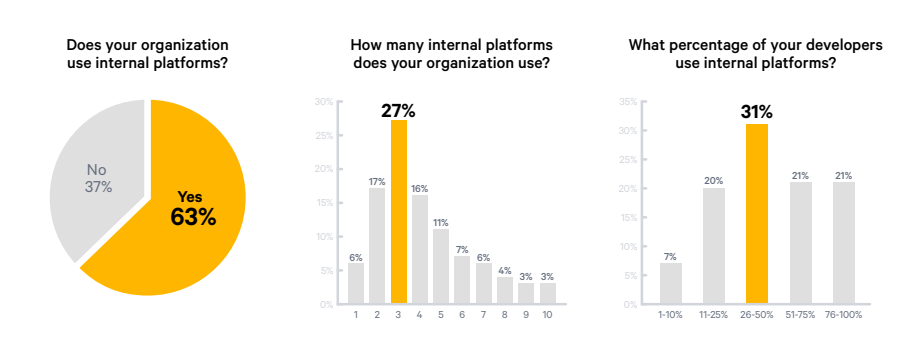
According to a survey sponsored by CircleCI and Puppet, DevOps and platforms go hand in hand. The survey of 2400 information technology professionals globally looked at “platform models,” defined in yet another way. 


And though many looking at AIOps might consider the use of external computing-as-a-service resources a primary driver of need for AIOps, the survey takes a different approach, limiting “platform” to internal resources only. 


As always, the definition of “platform” really does matter. 


source: CircleCI 


“Broadly speaking, the platform team provides the infrastructure, environments, deployment pipelines and other internal services that enable internal customers — usually application development teams — to build, deploy and run their applications,” the study states.


Likewise, “a digital platform is a foundation of self-service APIs, tools, services, knowledge and support which are arranged as a compelling internal product,” says Evan Bottcher, Thoughtworks Australia head of engineering.  


The report uses the term "internal platform" to mean one that's been built by and for the organization. So AWS or other IaaS offerings would not be thought of as "platforms” in this context.


“In our survey, we defined platform teams as those that are responsible for maintaining a self-service platform other teams use to build and deliver applications or services,” CircleCI says.


Thursday, June 10, 2021

41% of Surveyed U.K. IT Staffs Investing in AIOps in 2021

As some observers note,  if all an enterprise is doing is monitoring bare-metal servers and networks in its own data center, “you can probably keep on using your legacy monitoring tools.”


Cloud computing, most would agree, changes matters. Applications running virtually, using cloud service providers plus in-house resources require a new set of monitoring tools. 


In 2021, U.K. technology executives have prioritized information technology operations management  tool investments such as hybrid infrastructure monitoring (51 percent), AIOps (48 percent), and cloud native observability (47 percent). Digital experience monitoring (46 percent) and Application performance monitoring (46 percent) tools are right behind, says OpsRamp, citing research by McKinsey Global. 


source: OpsRamp 


“Siloed tools have historically created problems for hybrid infrastructure management as they offer limited context for assessing the health and performance of an IT service,” says OpsRamp. “Our survey shows AIOps (48 percent) is a focus area for tools consolidation, though it trails network performance monitoring (56 percent) and hybrid infrastructure monitoring (54 percent).”

Saturday, May 1, 2021

IBM Buys Turbonomic for Hybrid Cloud AIOps

IBM is acquiring Turbonomic, an application resource management (ARM) and network performance management (NPM) software provider based in Boston, Mass. 


IBM says the acquisition will make it “the only company that will be able to provide customers with AI-powered automation capabilities that span from AIOps (the use of AI to automate IT operations) to application and infrastructure observability, all built on Red Hat OpenShift to run across any hybrid cloud environment.” 


The acquisition will provide businesses with “full stack application observability and management” of containers, virtual machines, servers, storage, networks, and databases, IBM says, while also providing such value at lower cost in hybrid cloud environments. 


The acquisition complements IBM's recent acquisition of Instana for application performance monitoring (APM) and observability, and the launch of IBM Cloud Pak for Watson AIOps to automate IT Operations using AI. 


MWC and AI Smartphones

Mobile World Congress was largely about artificial intelligence, hence largely about “AI” smartphones. Such devices are likely to pose issue...