Thursday, April 14, 2022

High Metaverse Interest Also Means High Use of AI

If you have done consumer market research, or at least learned about such research, you know that what people say and what they do are two different things, typically. Still, a sruvey by Morning Consult finds half of younger adults “interested” in the mataverse, which almost by definition has to be powered by artificial intelligence in some form.


source: Morning Consult

Sunday, April 10, 2022

Hear Val Kilmer's AI Voice


All this speech is generated by artificial intelligence, as actor Val Kilmer no longer can speak as he once did. Talk about "giving voice to the voiceless."

Saturday, April 9, 2022

Why EleutherAI GPT-NeoX-20B Open-Source Language Model Matters


Natural language systems are important for many artificial intelligence use cases, ranging from chatbots, translations of  natural language into structured query language, application layouts and spreadsheets, and web search.

And one key to wider use of natural language machine learning is the availability of powerful open source tools. 

Up to this point, huge amounts of computer power and electrical power have been required to support natural language processing. EleuterAI's GPT-NeoX-20B removes that barrier for developers. 

Sunday, April 3, 2022

Metaverse Drives Edge Computing

As video content distribution has shaped global demand for inter-continental data transport and high-speed connections between major data centers, the metaverse will shape data center and connectivity network requirements. And the key words are “more” and “less.”


More bandwidth; less latency. More artificial intelligence; less centralized computing. More at the edtge; less in the core. More symmetrical bandwidth, less copper.


“Making the metaverse a reality will require significant advancements in network latency, symmetrical bandwidth and overall speed of networks,” says Dan Rabinovitsj, Meta VP for connectivity. 


The metaverse “will require innovations in fields like hybrid local and remote real-time rendering, video compression, edge computing, and cross-layer visibility, as well as spectrum advocacy, work on metaverse readiness of future connectivity and cellular standards, network optimizations, improved latency between devices and within radio access networks (RANs), and more,” he says. 


Already, experts predict Metaverse environments will require more data centers, more edge computing, more distributed computing, more collocation, more content distribution mechanisms, will require more power consumption and more cooling.


Eventually, fully-developed metaverses will require advances in chip technology as well. Beyond all that, blockchain will probably be necessary to support highly-decentralized value exchanges. And it is impossible to separate metaverse platforms and experiences from use of artificial intelligence, for business or consumer uses. 

source: iCapital Network 


If metaverses are built on persistent and immersive computing and tightly-integrated software stacks, platforms will be necessary. New developments in chip manufacturing also will be needed. 


For connectivity providers--especially internet service providers--far lower latency will be key. Today’s latency-sensitive applications such as video calling and cloud-based games have to meet a round-trip time latency of 75 milliseconds to 150 ms. Multi-player, complex games might require 30 ms latency. 


“A head-mounted mixed reality display, where graphics will have to be rendered on screen in response to where someone is focusing their eyes, things will need to move an order of magnitude faster: from single to low double digit ms,” says Rabinovitsj. 


Image rendering will require edge computing. “We envision a future where remote rendering over edge cloud, or some form of hybrid between local and remote rendering, plays a greater role,” he adds. “Enabling remote rendering will require both fixed and mobile networks to be rearchitected to create compute resources at a continuum of distances to end users.”


Bandwidth could increase by orders of magnitude over what is required to view 720p video on a standard smartphone screen. That might work with just 1.3 Mbps to 1.6 Mbps of downlink throughput. 


But a head-mounted display sitting just centimeters from the eyes required to display images at retina grade resolution will need to be many orders of magnitude larger, he notes. 


To be sure, most of what happens that is part of metaverse experiences rests on things that happen up the stack from computing and communications. 
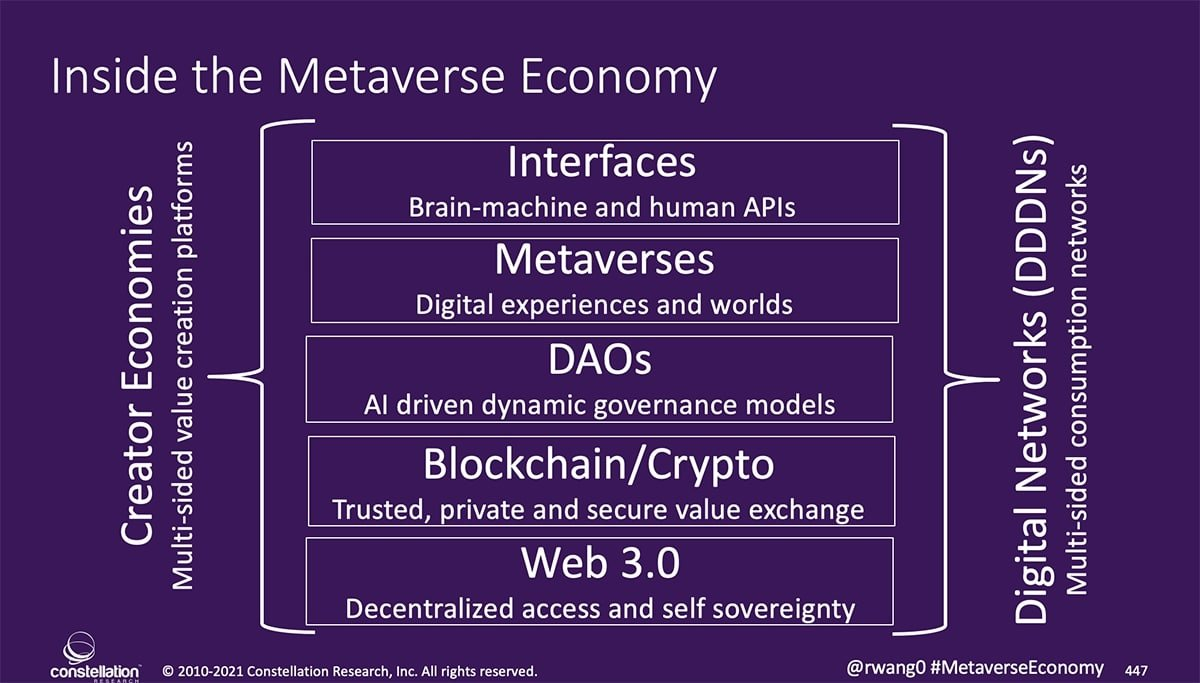

source: Constellation Research


But we already can see how metaverse support will require changes in computing architecture and network capabilities.


Tuesday, March 29, 2022

Digital Twin Applications Likely to be Commercial Before Many Metaverse Apps

Though consumer applications for metaverse seem to get more attention, digital twins are likely to produce more value, near term. 


A digital twin is a virtual representation of an object or system and is a type of “metaverse.”  It is updated from real-time data and uses simulation, machine learning and reasoning to help decision making, often to model processes and flows. 


That might be especially useful for complex systems, as when operators of such systems want to look at possible changes; predict breakdowns or predict maintenance activities. 

source: Leeway Hertz


When used to monitor and possibly avoid traffic congestion, digital twins might be useful to optimize traffic flows. Rerouting traffic around accident delays is one possible advantage, assuming the ability to manage traffic lights, open or close routes. 


In manufacturing, digital twins might be used to rapidly create prototypes or optimize supply chain support. In health care, assuming the knowledge base is refined enough, digital twins might help doctors evaluate outcomes from various treatments.  

Sunday, March 27, 2022

Will Current AI Interest Produce Spring, or Another Winter?

Does our experience with mobile computing have relevance for our predictions about useful and commercial use cases for artificial intelligence? Possibly. 


Initially, mobile internet, for example, was sort of a “mobile version” of the desktop experience, allowing users to keep doing things they were doing at their desks. But the mobile experiences sometimes were "de-featured" versions of what could be done on desktop devices. Mobile email was a salient exception: mobile utility was higher and ease of use about the same.


The analogy is mobile voice, which allowed communications away from the desk or cordless phone. Lots of value was created.


Then we moved into an era where the mobile device was the preferred device for many use cases, including photo sharing and social media. 


The proliferation of mobile apps was a characteristic of that era, where hotel check-in, for example, was expected to be invoked on a mobile device. 


Now there are many use cases where mobile is itself the native environment, preferred to desktop use cases which do not work as well, if at all.  Turn-by-turn driving instructions or ride-hailing services provide examples. 


source: Medium 


So are there implications for adoption of practical AI? Maybe. 

The difference in the case of AI is that development has not been strictly linear. At least in terms of expectations, we have moved through alternating periods where expectations were greater or lesser. 


It might be quite fair to say that interest in the near-term value of artificial intelligence has moved through periods of inflated expectations before, even if we are at present in a period of high anticipation. 


source: Saegus 


Historically, interest in the immediate value of artificial intelligence has waxed and waned. 

source: Medium

Friday, March 25, 2022

MWC and AI Smartphones

Mobile World Congress was largely about artificial intelligence, hence largely about “AI” smartphones. Such devices are likely to pose issue...