Sunday, November 20, 2022

70% of Digital Transformation Efforts Fail

Perhaps only fools or those without the means refuse to take advantage of obviously-useful new tools and technology  On the other hand, we possibly should stop fetishizing the use of new tools. By all means, explore the application of artificial intelligence, virtual reality, augmented reality, internet of things, network slicing, 5G, 6G, the internet and so forth.


New technologies will be applied. But maybe we should stop confusing the matter by insisting that "digital transformation" is qualitatively different from all the other adaptations we have made over the decades and centuries.


Looking only at agriculture, we can note the application of new technology over time, that has transformed that business and pursuit.


source: Researchgate 


But all that happens whether the term "digital transformation" exists, or not. And keep in mind that 
70 percent or more DX efforts will fail. In fact, that has been true of information technology programs in the past. 

“74 percent of cloud-related transformations fail to capture expected savings or business value,” say McKinsey consultants  Matthias Kässer, Wolf Richter, Gundbert Scherf, and Christoph Schrey. 


Those results would not be unfamiliar to anyone who follows success rates of information technology initiatives, where the rule of thumb is that 70 percent of projects fail in some way.


Of the $1.3 trillion that was spent on digital transformation--using digital technologies to create new or modify existing business processes--in 2018, it is estimated that $900 billion went to waste, say Ed Lam, Li & Fung CFO, Kirk Girard is former Director of Planning and Development in Santa Clara County and Vernon Irvin Lumen Technologies president of Government, Education, and Mid & Small Business. 


That should not come as a surprise, as historically, most big information technology projects fail. BCG research suggests that 70 percent of digital transformations fall short of their objectives. 


From 2003 to 2012, only 6.4 percent of federal IT projects with $10 million or more in labor costs were successful, according to a study by Standish, noted by Brookings.


IT project success rates range between 28 percent and 30 percent, Standish also notes. The World Bank has estimated that large-scale information and communication projects (each worth over U.S. $6 million) fail or partially fail at a rate of 71 percent. 


McKinsey says that big IT projects also often run over budget. Roughly half of all large IT projects—defined as those with initial price tags exceeding $15 million—run over budget. On average, large IT projects run 45 percent over budget and seven percent over time, while delivering 56 percent less value than predicted, McKinsey says. 


Beyond IT, virtually all efforts at organizational change arguably also fail. The rule of thumb is that 70 percent of organizational change programs fail, in part or completely. 


There is a reason for that experience. Assume you propose some change that requires just two approvals to proceed, with the odds of approval at 50 percent for each step. The odds of getting “yes” decisions in a two-step process are about 25 percent (.5x.5=.25). 


In other words, if only two approvals are required to make any change, and the odds of success are 50-50 for each stage, the odds of success are one in four. 


The odds of success get longer for any change process that actually requires multiple approvals. 


Assume there are five sets of approvals. Assume your odds of success are high--about 66 percent--at each stage. In that case, your odds of success are about one in eight for any change that requires five key approvals (.66x.66x.66x.66x.66=82/243). 


In a more realistic scenario where odds of approval at any key chokepoint are 50 percent, and there are 15 such approval gates, the odds of success are about 0.0000305. 


source: John Troller 


So it is not digital transformation specifically which tends to fail. Most big IT projects fail.

If one defines digital transformation “as the integration of digital technology into all areas of a business resulting in fundamental changes to how businesses operate and how they deliver value to customers,” you can see why it is so hard to measure. 


DX affects “all” of the business; produces “fundamental change” in “operations and value” creation, it often is said. How often does any single technology change or program affect “the whole business?” How often does any technology program produce “fundamental change” in operations or value creation? 


Also, by that standard of “fundamental change,” many industries arguably already have achieved most of the value of DX. If “value for customers” is correlated with “how we make our money,” then content businesses and many retailers already have succeeded, for the most part. They sell online; they fulfill remotely; they handle customer interactions online. 


CaixaBank Research


Many other industries, such as marketing, consulting and research, likewise largely rely on online processes and fulfillment. Other industries possibly cannot pursue “fundamental transformation.” 


The qualifications, such as saying DX “will look different for every company,” only highlight  the problem. DX requires technology, to be sure, but also cultural change. And how do you measure that? 


Some might say DX requires a “culture of experimentation; a willingness to fail or an ability to successfully challenge older ways of doing things.” Some of us would say success in any single one of those areas will succeed only about 30 percent of the time. 


So what people often do not expect is failure. And there is no reason to believe any single effort at some part of DX will succeed more often than three times out of 10. 
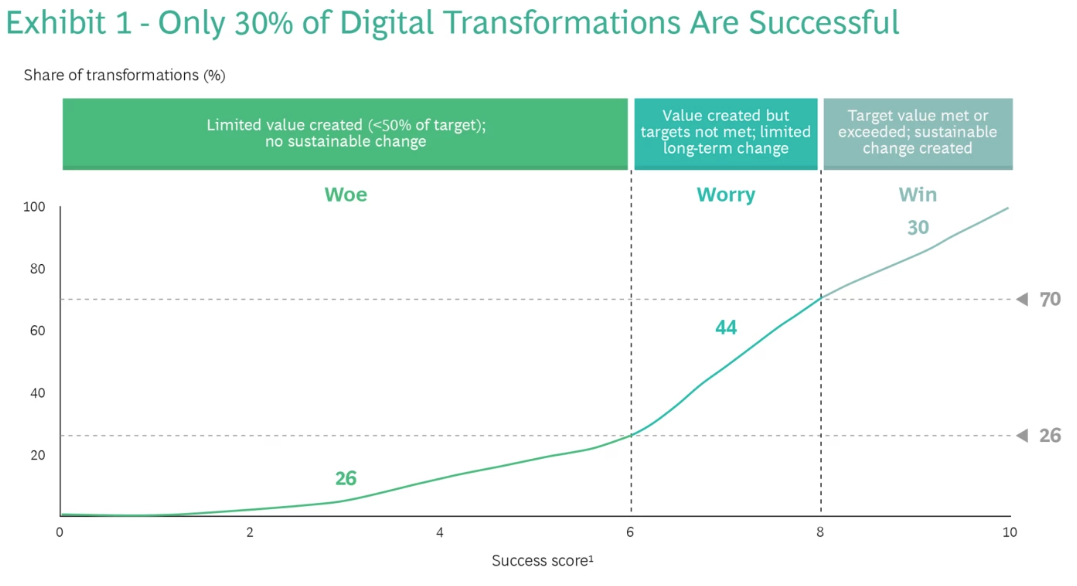

source: BCG 


The e-conomy 2022 report produced by Bain, Google and Temasek provides an example of why DX is so hard to define or measure. Literally “all” of a business, all processes and economic or social outcomes are linked in some way to applied digital technology. 


And what we cannot precisely quantify or measure is hard to track or monitor. If one thinks of DX as simply the latest description of “applying digital technology” to processes, then one also understands why there actually is no end point. We simply keep evolving our technology use over time. 

source: Harvard Business Review 


We should not expect people and organizations to stop talking about “digital transformation.” But maybe we shouldn’t listen quite so much. 


source: The Marketing Technologist 


Yes, by all means continue to experiment with new ways to apply internet, communications and  computing technologies to improve operations, product value and customer interaction capabilities.


But we also should understand that some businesses and industries make money pushing "digital transformation." That is just reality. They make money even if you do not.


And it always is harder than it might seem.


So maybe it is time to stop paying attention. Apply new tools as you can see the value. You know, like we always have done. But tune out the hype.


Tuesday, November 15, 2022

Why Telcos Might Use Public Cloud Even if it is Not Cheaper than Private Cloud

One reason enterprises might eventually rethink why, where and how they use public cloud--including access service providers--are the normal economies of scale that apply to enterprise computing at scale. In almost every case, small volume tends to support the economics of a cloud approach that comes with leased access to compute cycles. 


But in almost every case, very-high volume tends to shift economics back to ownership. In other words, pay-per-use is affordable at low use volumes but increasingly expensive as volume grows. At some point, as the number of instances, licenses, subscriptions or other usage metrics grow very large, ownership starts to offer lower cost.


Private Cloud, Public Cloud, On-Premises Stack Considerations

Issue

Private cloud

Public cloud

Public cloud on-premises stack

Financial treatment

Capital expenditure

Operational expense (opex)

Operational expense

Capital investment

Required

None (costs were opex)

Commodity

Operational expense

People, environmental, space, maintenance

Consumption-based

People, environmental, space, maintenance

Existing infrastructure

Sunk cost, repurpose

Excess

Excess

Consistent operations

High with control of hardware and software

Variability when using multiple public clouds

Variability when choosing more than one solution

People

High

Low/medium

Medium, depending upon support

Capacity provisioned/scaling

Provision to peak demand. Slower to scale beyond

Public cloud provider can absorb surge in traffic

Provision to peak demand. Could burst/ scale into public cloud.

Life cycle

Control selection and upgrades of hardware and software

Controlled by cloud provider

Controlled by cloud provider

Demand variability

Predictable, less variable demand; must plan capacity

Variable demand supported by cloud infrastructure

Less variable demand to fit capacity; could burst to public cloud

Cost per traffic volume

Cost per gigabyte can be lower for high volume

Cost efficient for low volume or varied traffic patterns

Cost per gigabyte can be lower at high volume

Application dependencies (e.g., multicast, real-time, network fabric, VxLAN)

Adaptable, customizable to meet complex requirements

Most are not supported. Standard compute, memory, storage, network. May offer telco services.

Most are not supported. Standard compute, memory, storage, network. 

Compute intensity

GPU, CPU pinning under control

Extra costs for GPU, no CPU pinning

Extra costs for GPU, no CPU pinning

Storage intensity

Control storage costs and performance

High cost of storage services

High cost of storage services

Data privacy and security

Control

Some providers may collect information

Some providers may collect information

Location and data sovereignty

Control

Country- and provider-dependent

Control

Regulatory compliance

Built to requirements

May not meet all requirements

May not meet all requirements

Portability and interoperability

High within private cloud environment

Lower when public cloud(s) used with private cloud

Lower when public cloud(s) used with private cloud

Intellectual property

Owned, controlled, managed. Can differentiate offers.

Subject to terms of service. Can add cost, limit differentiation.

Subject to terms of service. Can add cost, limit differentiation.

source: Red Hat 


The key, though, is whether the “owned” capabilities are functionally similar to the leased facilities. And that might be the key insight about access service providers using public cloud for their computing infrastructure. The advantages of using public cloud might, in fact, not be scale advantages at all, but the ability to take advantage of the most-advanced and up-to-date computing architectures. 


Flexibility and agility or skills availability might be cited as advantages for using a public cloud, but those same advantages might be attributed to sufficiently-large private clouds as well. The issue there is “might be.” If there are advantages to scale for cloud computing, then perhaps private cloud as built by an enterprise. never can approach the scale advantages of a public cloud supplier.


But again, scale advantages might not be the main issue. Even when reliance on public cloud costs more than an equivalent private cloud, the perceived upside of using public cloud might lie in its expected advantage for creating new applications and use cases at scale. 


In other words, customers might trade higher cost for higher agility. Those with long memories will recall the operational problems caused by many decades of accumulated proprietary telco operations support systems, for example. 


The shift to reliance on public clouds for OSS type functions is a move to eliminate the downside of proprietary approaches and legacy solutions.


Sunday, November 13, 2022

Brace for 70% Failure Rates for AI Initiatives

It long has been conventional wisdom that up to 70 percent of innovation efforts and major information technology projects fail in significant ways, either failing to produce predicted gains, or producing a very-small level of results. If we assume applied artificial intelligence, virtual reality, metaverse, web3 or internet of things are “major IT projects,” we likewise should assume initial failure rates as high as 70 percent.


That does not mean ultimate success will fail to happen, only that failure rates, early on, will be quite high. As a corollary, we should continue to expect high rates of failure for companies and projects, early on. Venture capitalists will not be surprised, as they expect such high rates of failure when investing in startups. 


But all of us need to remember that failure rates for innovation generally and major IT efforts specifically will have high failure rates of up to 70 percent. So steel yourself for bad news as major innovations are attempted in areas ranging from metaverse and web3 to cryptocurrency to AR, VR or even less “risky” efforts such as internet of things, network slicing, private networks or edge computing. 


Gartner estimated in 2018 that through 2022, 85 percent of AI projects would deliver erroneous outcomes due to bias in data, algorithms or the teams responsible for managing them.


That is analogous to arguing that most AI projects will fail in some part. Seven out of 10 companies surveyed in one study report minimal or no impact from AI so far. The caveat is that many such big IT projects can take as much as a decade to produce quantifiable results. 


Investing in more information technology has often and consistently failed to boost productivity, or appear to have done so only after about a decade of tracking.  Some would argue the gains are there; just hard to measure, but the point is that progress often is hard to discern. 


Still, the productivity paradox seems to exist. Before investment in IT became widespread, the expected return on investment in terms of productivity was three percent to four percent, in line with what was seen in mechanization and automation of the farm and factory sectors.


When IT was applied over two decades from 1970 to 1990, the normal return on investment was only one percent.


This productivity paradox is not new. Even when investment does eventually seem to produce improvements, if often takes a while to produce those results. So perhaps even AI project near-term failure might be seen as a success a decade or more later. 


Sometimes measurable change takes longer. Information technology investments did not measurably help improve white collar job productivity for decades, for example. In fact, it can be argued that researchers have failed to measure any improvement in productivity. So some might argue nearly all the investment has been wasted.


Most might simply agree  there is a lag between the massive introduction of new information technology and measurable productivity results.


Most of us likely assume quality broadband “must” boost productivity. Except when it does not. The consensus view on broadband access for business is that it leads to higher productivity. 


But a study by Ireland’s Economic and Social Research Institute finds “small positive associations between broadband and firms’ productivity levels, none of these effects are statistically significant.”


Among the 90 percent of companies that have made some investment in AI, fewer than 40 percent report business gains from AI in the past three years, for example.


MWC and AI Smartphones

Mobile World Congress was largely about artificial intelligence, hence largely about “AI” smartphones. Such devices are likely to pose issue...