Wednesday, April 27, 2022

AI Has Been a Long Time Coming

Some technology transformations are so prodigious that it takes decades for mass adoption to happen. We might point to artificial intelligence or virtual reality as prime examples. AI is not a new concept. But its usefulness and cost have been slowly developing for decades.


AI software revenues, for example, are still at an early stage, after decades of research and evelopment work. And it likely will take longer than we think for AI to be so ubiquitous we no longer notice it.


Now we probably can add Web 3.0 and metaverse to that list of key technology innovations.


At a practical level, we might also point to the delay of “new use cases” developing during the 3G and 4G eras. That is likely to happen with 5G as well. Some futuristic apps predicted for 3G did not happen until 4G. Some will not happen until 5G. Likely, many will not mature until 6G. 


The simple fact is that the digital infrastructure will not support metaverse immersive apps, as envisioned, for some time. Latency performance is not there; compute density is not there; bandwidth is not there. 


In fact, it is possible to argue that metaverse is itself digital infrastructure, as much as it might also be viewed as an application supported by a range of other elements and capabilities, including web 3.0, blockchain and decentralized autonomous organizations, artificial intelligence, edge computing, fast access networks and high-performance computing. 
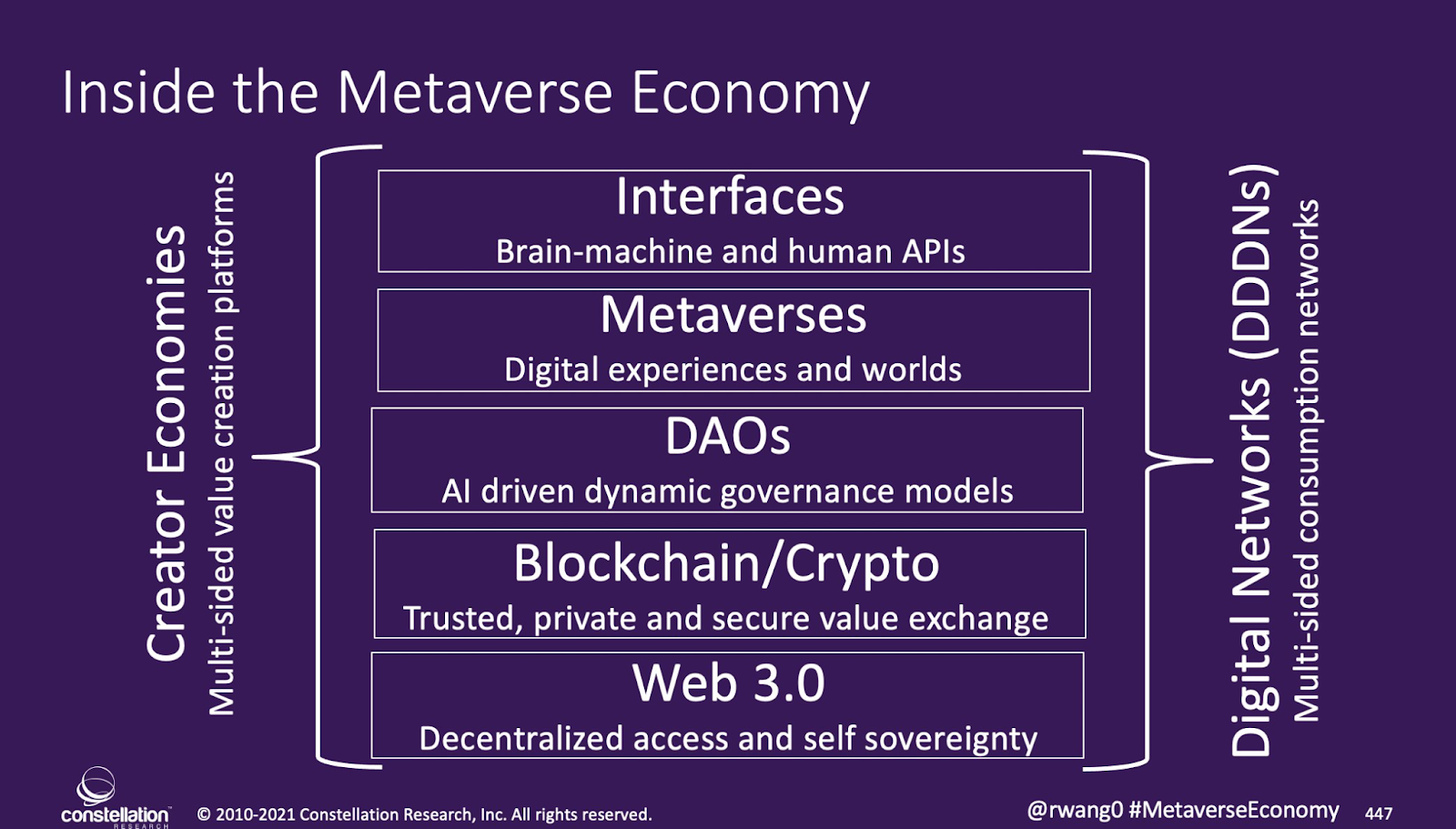

source: Constellation Research 


Scaling persistent, immersive, real-time computing globally to support the metaverse will require computational efficiency 1,000 times greater than today’s state of the art can offer, Intel has argued. 


To reduce latency, computing will have to move to the edge and access networks will have to be upgraded. 


All of that takes time, lots of capital investment and an evolution of business models and company cultures. Metaverse is coming, but it is not here today, and will take a decade or more to fully demonstrate its value. Major technology transformations are like that.

Sunday, April 24, 2022

Metaverse Without Ai is not Likely, or Possible

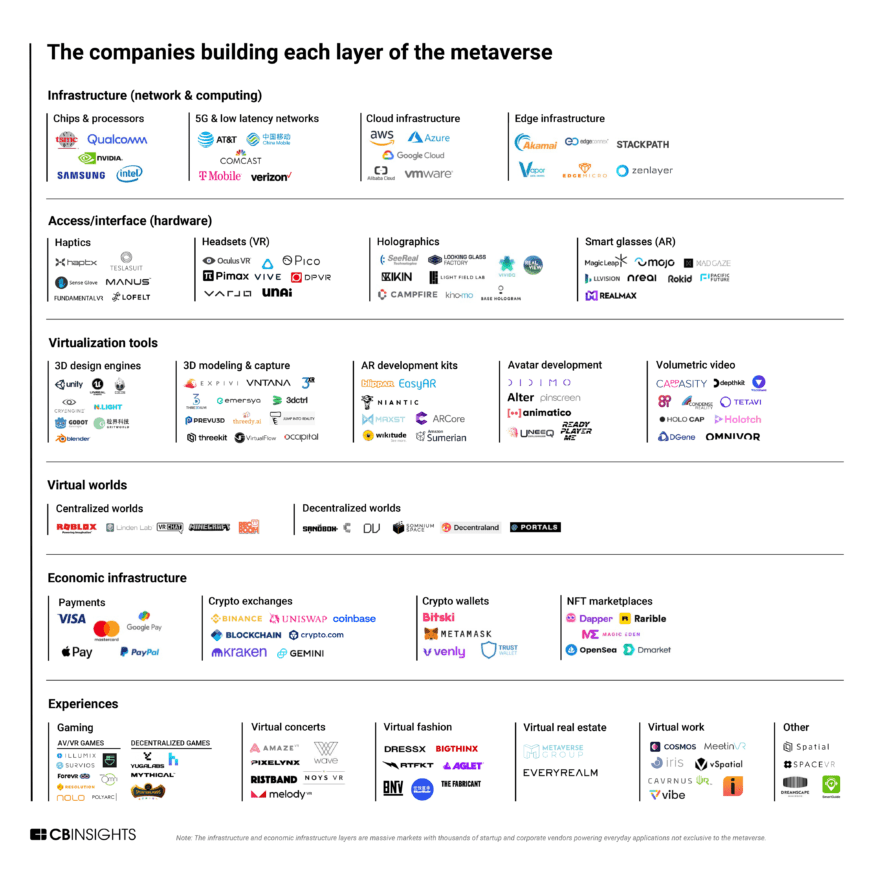
It is possible to predict that edge data centers and edge data processing will be foundational for support of metaverse applications and use cases. Likewise, immersive environments seem impossible without heavy use of artificial intelligence.


But it also is possible to predict that much more orchestration of data and computng from many sources also will be required, again using AI to manage the orchestration process.


In fact, improvements seem likely almost everywhere, from chips and algorithms to devices to connectivity and computing infrastructures. 

source: CB Insights 


Much as today’s web pages are essentially assembled in real time, so too metaverse experiences and other immersive applications will require assembling elements from many sources, in real time. That will require much more real-time communication and computing, and likely more server denstiy as well


Architectures that are more open also are likely. Edge computing, hybrid local and remote real-time rendering, video compression, cross-layer visibility, network optimizations and improved latency between devices and within radio access networks all seem necessary. 


Friday, April 22, 2022

Move to Public Cloud Drives Need for More Management

It would be reasonable to predict that end-user cloud spending might shift over time towards features that aim to monitor cloud resource performance, in large part because the proliferation of cloud-native resources and multi-cloud usage makes management more tricky. 


In other words, public cloud computing spend grows both because computing chores are moved to public cloud, but also because that movement itself increases the complexity of IT management, requiring additional spending on monitoring and management.

source: Gartner 


If one assumes total business IT spending is around $4.5 trillion, then public cloud could support about 13 percent of total IT spending globally in 2023. 


Global  Public Cloud Services End-User Spending Forecast (Millions of U.S. Dollars)


2021

2022

2023

Cloud Business Process Services (BPaaS)

51,410

55,598

60,619

Cloud Application Infrastructure Services (PaaS)

86,943

109,623

136,404

Cloud Application Services (SaaS)

152,184

176,622

208,080

Cloud Management and Security Services

26,665

30,471

35,218

Cloud System Infrastructure Services (IaaS)

91,642

119,717

156,276

Desktop as a Service (DaaS)

2,072

2,623

3,244

Total Market

410,915

494,654

599,840

source: Gartner


Thursday, April 14, 2022

High Metaverse Interest Also Means High Use of AI

If you have done consumer market research, or at least learned about such research, you know that what people say and what they do are two different things, typically. Still, a sruvey by Morning Consult finds half of younger adults “interested” in the mataverse, which almost by definition has to be powered by artificial intelligence in some form.


source: Morning Consult

Sunday, April 10, 2022

Hear Val Kilmer's AI Voice


All this speech is generated by artificial intelligence, as actor Val Kilmer no longer can speak as he once did. Talk about "giving voice to the voiceless."

Saturday, April 9, 2022

Why EleutherAI GPT-NeoX-20B Open-Source Language Model Matters


Natural language systems are important for many artificial intelligence use cases, ranging from chatbots, translations of  natural language into structured query language, application layouts and spreadsheets, and web search.

And one key to wider use of natural language machine learning is the availability of powerful open source tools. 

Up to this point, huge amounts of computer power and electrical power have been required to support natural language processing. EleuterAI's GPT-NeoX-20B removes that barrier for developers. 

MWC and AI Smartphones

Mobile World Congress was largely about artificial intelligence, hence largely about “AI” smartphones. Such devices are likely to pose issue...